Monday, October 1, 2012

Second-Chance Animals Become Educational Ambassadors


Wildlife Sanctuary Brings Together Rescued Animals and Troubled Youth 


Two young grey foxes following their mother through a schoolyard in Arizona suddenly found themselves in an extraordinary situation when the school bell rang for recess. Children poured out of their classrooms and, instinctively, the mother fox dashed for cover. Too young to escape, the two young kits were left behind.
The children quickly found the kits and approached them. First one child, then another, began throwing stones at them. Finally, someone stepped forward to protect them.
The orphaned foxes are now living at an animal sanctuary called Wildlife Associates in Half Moon Bay. Named Tahoe and Tucson, they are animal ambassadors in educational programs designed to teach children about wildlife in an effort to prevent the kind of suffering they endured.
Tessa Teichert, wildlife educator, presents Savannah, an African serval,
as part of the Wildlife Associates education program.
By teaching children at a young age to value wild animals, Wildlife Associates aspires to reach youth when they are most impressionable, so that given the same situation of encountering wild animals, children might recognize the need to protect the animals and respect them as gifts of nature.
Steven Karlin, the executive director, combines his background in environmental science with a teaching style that integrates the art of storytelling. “The earliest cave paintings are not of people; they are of people and their relationships with animals,” he explains. “Fostering a sense of wonder, empathy and love for wildlife is central to the educational programs.”
Michelle Durant, assistant director, engages children in a conversation about respecting
wild animals during a presentation to day campers at Redwood Grove.
Professional animal handlers travel to schools, camps and libraries to present up to five animals to students. The program charges the schools a fraction of the actual cost of the education program and the remaining cost is subsidized by the generosity of donors, foundation grants and corporate support.
Wildlife Associates cares for 45 to 50 non-releasable animals that would not survive on their own and commits to caring for them for the rest of their lives. The animals accepted at the sanctuary come from the U.S. Fish and Wildlife Service, the California Department of Fish and Game, wildlife rehabilitation centers, and humane societies.
Some are rare and endangered species that have suffered illness, abandonment or injury. But Karlin looks past their predicaments and searches for signs of behavioral suitability so they may join the program. If the animal can be nurtured back to health, it may begin its new life as an animal ambassador.
In some cases, Karlin needs to earn back the animals’ trust of humans. But he is not faint of heart. His determination and passion for helping animals is evident in his sincerity. At the same time, his sense of humor and youthful joy is refreshing and contagious.
Over the years the program has expanded to include adults and corporate events, but the focus remains on reaching children. At-risk youth and foster children are close to Karlin’s heart, and the program is designed to bring these kids on-site to the sanctuary. Bringing together traumatized kids and rescued animals has a transformative effect.
Steven Karlin, executive director at Wildlife Associates, and the rescued
Canadian lynx, Tacoma, have forged a lifelong bond at Wildlife Associates.
At the sanctuary, the Andean condor named Veedor has a commanding position high on his perch. The raptor is large, with a bald-looking head and a white collar around its neck. Veedor looks wise and regal. When foster kids visit the sanctuary, Karlin invites them to sit on the grass at the foot of the condor’s massive enclosure and ask a silent question that has been on their mind.
Karlin explains to them, “The first soft voice you hear may be Veedor answering your question.” Sometimes a child will be moved to tears. Karlin smiles and explains that we all have the answers within ourselves; we just have to be quiet enough to listen. “We give them a magical place to be who they are,” he says.
Since 1980, the Wildlife Associates programs have reached an astounding 8 million children in Northern California. What motivated Karlin to create such an impressive program? Not surprisingly, he explains by telling a story.
One day, he came home and there was black smoke billowing from the backyard. He ran to see the baby robins, but instead saw a bulldozer. The tree was lying on the ground. The babies were dead. And the two robins were circling overhead, screaming.As a third grader, he befriended two robins living in the tree near his home. It took time to earn their trust and sit in the tree branches alongside them. Eventually, the robins felt comfortable with his presence and built their nest and laid their eggs. Soon, the chicks emerged.
“I promised myself that I would do something that had meaning in this world that would protect them,” Karlin says. “And teach people that they have to think and feel before they act. They have to understand that we’re all connected. … So I had a lesson. Those two robins mentored me into what I’m doing today.”
Wiyaca is an American kestrel who lives at the sanctuary.
Wildlife Associates teaches about nature’s web of existence. On a sunny Thursday morning in Redwood Grove near Los Altos Hills, Tessa Teichert, wildlife educator, and Michelle Durant, assistant director, present a serval, a hawk, a kestrel and a porcupine to a group of day-campers, ages 4-6 years old.
The children are asked to sit quietly and save their questions, a tall order for fidgety youngsters. Yet, as Durant begins her narrative, the kids are attentive. And as the black-spotted paws of an African serval step out of the white van onto the forest floor, the kids become still. To everyone’s delight, Teichert introduces the wild cat, Savannah.
Durant engages the kids with fascinating details about Savannah’s habitat, diet and behavior. Animals are respectfully presented in short durations and students are not allowed to touch or approach them. Storytelling is a key component in how Durant communicates with the kids, and her message focuses on empathy.
“Wild animals have feelings and emotions because they’re alive, just like us. What makes them so different is the way they think about the world around them. And sometimes when things are different, they’re hard to understand. So what we try to do at Wildlife Associates is teach people about these amazing animals … so the next time you see a wild animal or learn about them, they’re easier to understand and to respect,” she explains.
Back at the sanctuary, Karlin echoes this sentiment, saying: “We learn from science that animals have stored memories in sounds and pictures — not words and language that we use, but a different type of language … a consciousness all their own. They don’t feel pain like people do, but they feel it. And when the kids walk away, they’re living in a different world.”
One girl who visited the sanctuary said, “I wish there was a place where we can speak our truth and nobody would judge us.” Karlin replied, “This is a wildlife sanctuary. But this is also a sanctuary for people.” Introducing the kids to the animals can be a transformative experience. “Schools bring us back year after year because we make a difference in the kids. We make shifts.”
If you are interested in scheduling a school assembly program, or donating time or resources, please contact Bruce Holaday, development director, at 650-712-0800. http://www.wildlifeassociates.org/ 

Monday, July 30, 2012

The Chinese Social Media Landscape


An Inside Look at Making an Impression


Effectively using social media as a recruitment vehicle in China is a hot topic among staffing leaders at many U.S.-based multinational corporations. Who is the audience, what media is being used, and what are the barriers to entry?
The Internet audience in China is astounding. Ad Age reports there are 513 million Internet users, including 355 million mobile Internet users. And because Chinese job seekers tend to be passive in their job search, communication with these professionals needs to be smart and strategic.
In the first study of its kind, the 2011 China Social Network Employer Branding and Recruitment Survey discovered that 51% of Chinese HR professionals are actively using social media in their communication strategies. 69% are using social media for employer branding purposes, and 75% are using social media to keep in touch and recruit active job seekers.
While the activity is strong, implementing an effective social media strategy in China has its challenges that are worth exploring from both a US as well as a Chinese perspective.
Frank Xu, Account Director at PinCN, TMP’s network partner agency in Shanghai, observes that one of the first challenges local recruiters face in China is how to integrate social media into recruitment campaigns. Where does one begin? It is not uncommon for multi-national companies based domestically or abroad to experience the same slow start. While there is much discussion, the call to action can be slow.
For starters, a social strategy begins with establishing a plan. What is the goal, who is the audience, and how does one use the media? We can assume the goal is to engage talented professionals in a virtual conversation about your employer brand. So, let’s focus on the audience.
The Chinese are keenly aware of their position as an emerging market, and much of their focus centers on their own socio-economic development, according to AdAge Global.
As such, understanding basic Chinese values is imperative. According to S. Y. Lau, Sr. Executive VP at Tencent, Chinese consumers do not tend to be highly brand loyal. At the same time, Lau asserts that eye-catching visuals tend to be intriguing among Chinese consumers, as noted in AdAge Digital. Imagery can be an excellent tool for adding a layer of interest to a recruitment campaign as well, but valuable content should be the focus in developing a relationship with your employer brand. And it’s the development of this type of relationship that should be at the forefront of an employee engagement plan, as companies cannot rely on brand loyalty when courting talent in China.
The next component is using the media, and there lies the next stumbling block. As Xu explains, there is a general lack of knowledge on how to use social media or the tools to manage the campaign. Couple this with a crippling lack of available best practices to guide recruiters, and oftentimes Chinese campaigns hit a false start.
While all the same challenges apply to Western recruiters, there are added barriers to entry for US-based multinationals. So much so, that Ad Age’s Adam Lehman refers to the Chinese online space as the “other Internet.”
As Lehman points out, not only do the Chinese language and characters render content inaccessible, but the double-byte encoding used causes challenges for software based on the Latin alphabet. Governmental regulations and license requirements by the Chinese Ministry of Industry and Information Technology create further impediments for websites, both foreign and domestic.
Maintaining a positive social media image is very important to Chinese professionals, and along with that there is a strong desire for respect. “Chinese…seek respect, or ‘face,’ meaning a good reputation in front of one's peers,” writes AdAge Digital’s Laurel Wentz. At the same time, social media renders organizations vulnerable to negative feedback. In China, as in the US, some companies are more adept at responding to negative communications with openness, courage and the proverbial “reasons to believe,” according to Xu. All of these points can be addressed with a carefully planned social media strategy and a clear understanding of the audience.
So what are the social media sites in China? AdAge Global reports that Facebook and Twitter are often blocked by the government, but there are several Chinese media sites that have filled the gap, namely Tencent, Sina and RenRen.
How does this translate?
• Tencent Weibo: the Twitter equivalent and one of the hottest media in China.
• Sina Weibo: the most popular site among professionals, sometimes just referred to as “Weibo,” which is the Chinese word for microblog.
• Renren: the Facebook equivalent in China, which skews toward the young professional and undergraduate audience.
• Youku: the YouTube equivalent, which literally means "excellent (and) cool"; however, its utilization in recruitment is probably more on the horizon than useful now.
Strategic messaging about the employer brand coupled with valuable content and creative visuals are the cornerstones of a smart plan in any market. However, in China, multinational corporations who wish to be competitive for top tier talent will need to consider the many nuances of their messaging, respond appropriately to feedback, and keep their content engaging and appropriate to their target audience.
With such a large networked audience that is particularly sensitive to professional reputation, it is critical to get the social media strategy right the first time. It only takes one misstep to lose “face.” So, while your social media strategy in China make take some time to develop, making the right impression will be essential to its success.
Sources and References:
Wentz, Laurel. 2012. Understanding How the Internet Is Transforming Personal Connections in China. AdAge Digital (April 18).http://adage.com/article/special-report-digital-conference/web-transforming-personal-connections-china/234195/
Lehman, Adam. 2012. China: Can You Afford to Ignore the 'Other Internet'? AdAge Digital (April 30).http://adage.com/article/digitalnext/china-afford-ignore-internet/234459/
Madden, Normandy. 2012. Five Questions With Tom Doctoroff, JWT's Greater China CEO AdAge Global (June 27).http://adage.com/article/global-news/questions-tom-doctoroff-jwt-s-greater-china-ceo/235654/
Ad Age Staff, 2012. WPP's Kantar Buys China Social-Media Intelligence Expert CIC. AdAge Global (January 17).http://adage.com/article/global-news/wpp-s-kantar-buys-china-social-media-intelligence-agency-cic/232132/

Saturday, June 23, 2012

Mothers' Dinner by the Sea

People make the place, so they say, and I would have to agree. I would only add that special places tend to attract special people. That's what I've found here, just 45 minutes south of San Francisco, in what is affectionately known as the Coastside.

The Coastside Mother's Club has brought together women from Pacifica to Pescadero to share in the joys and challenges of motherhood. Time and again, I've been amazed by the genuine support and honest compassion these women have shown for one another, our children, and this seaside community.


When my second daughter was born a month early and my kitchen was still under construction, the group generously organized homemade meals delivered to my door for two months. For a mom without local family to provide support, this was a godsend. I couldn't imagine that show of community in any other place I've ever lived.


My parents had a wonderful tradition for many years of hosting potluck gourmet dinners with close friends. I wanted to recreate the concept in my adopted home town near Half Moon Bay and keep the relationships I'd forged going strong.

I found enthusiastic support in my friend, fellow mother and chef extraordinaire, Kate. She took the idea and ran with it hosting our first ever potluck dinner in May. It was a success and we quickly had another volunteer to host for June.

"Bring warm clothes. We'll probably be outside all evening." That was the text I received just as I arrived to our carpool destination. I had come straight from work in the city and was wearing a sweater and light jacket. I figured I'd be okay if the wind didn't pick up and the fog didn't roll in. We were in luck as it turned out to be a beautiful evening.

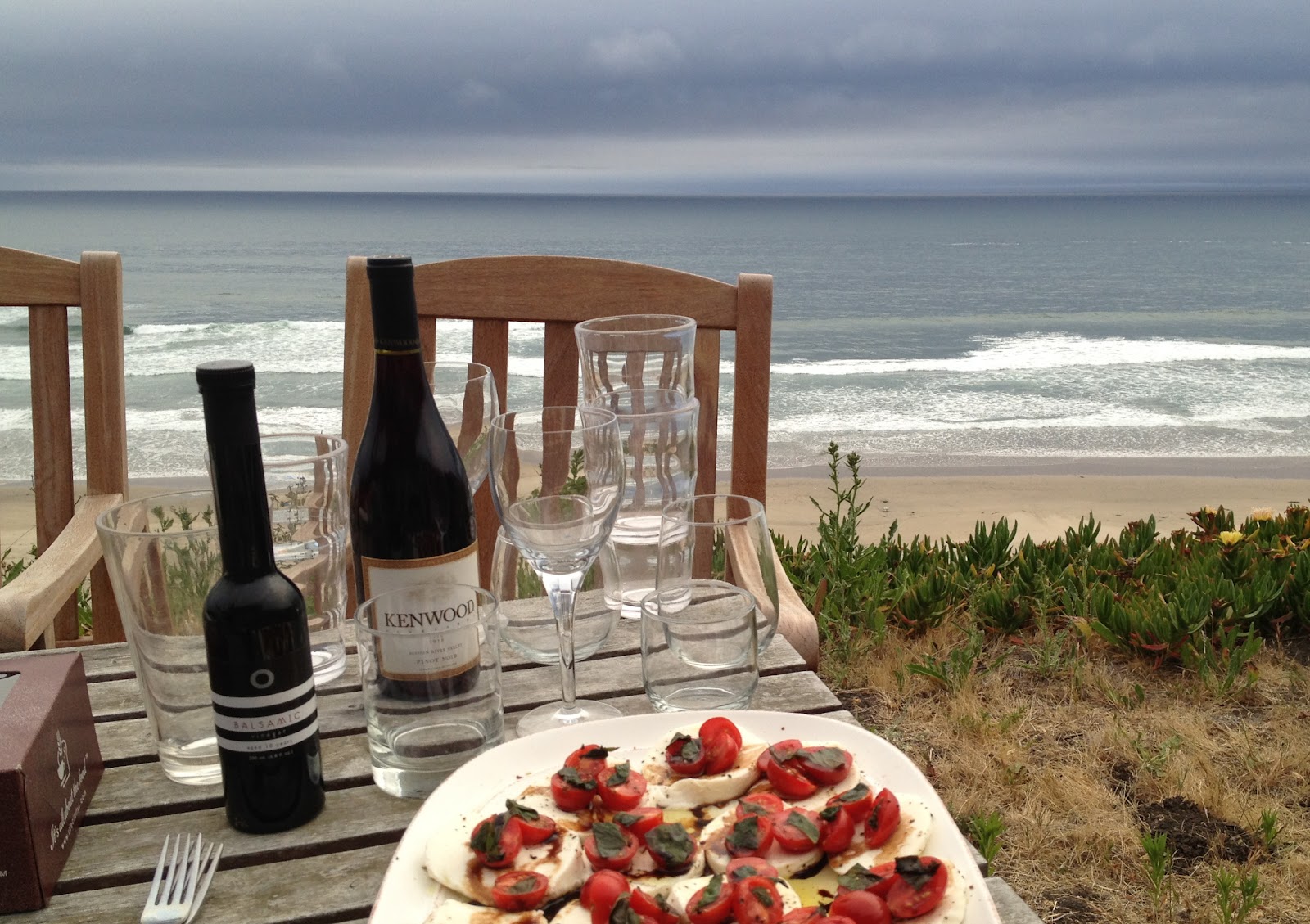
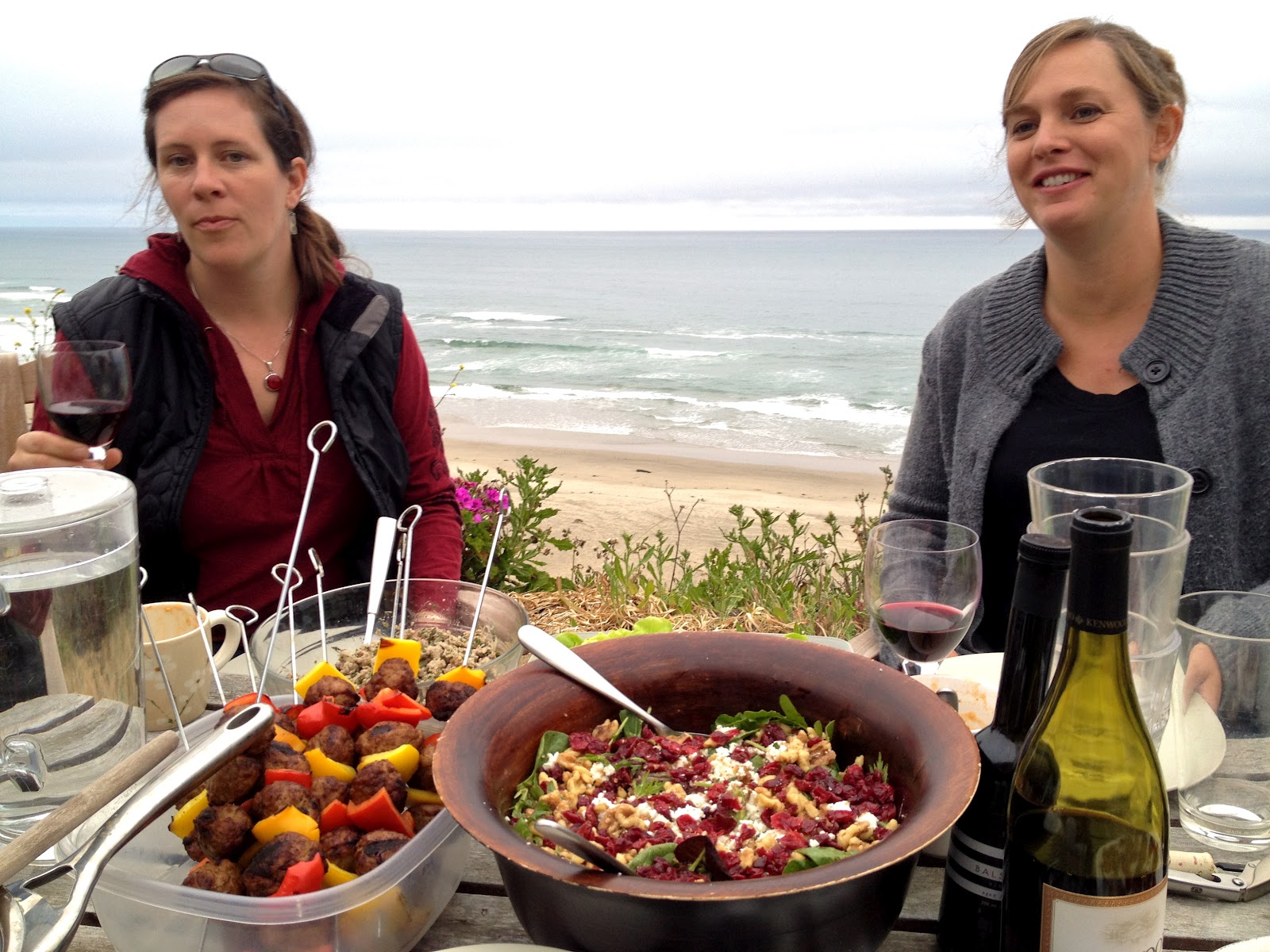
About five miles south of Half Moon Bay, we reached Jackie's cabin. Sitting right at the water's edge, our hostess had set up a casual table for serving and chairs around the fire pit for dining.

The women pulled through with amazing fare: teriyaki chicken kebabs, butter lettuce cups, mango rice, caprése, quinoa, bottles of wine and chocolate cake.

It was a beautiful evening of great conversation and companionship. The views of the Pacific were marvelously moody until the sun went down. Laughter became more abundant as the fire crackled and kept us warm and dry from the evening mist.

It's a rare event to meet women who are so warm and welcoming and to meet five in one evening is pure reassuring delight. I look forward to hosting the next month's event and the continued genuine camaraderie. Special places do indeed attract special people and I have come to feel rather at home in our small agricultural town by the sea.


Tuesday, October 5, 2010

The Tended Garden

Morning In The Fairy Garden
When the warm wind blows
and warms my skin
and the sun sinks in and
heats my bones
the air goes still and my
breath is quiet

Let the day
take me
where I belong
and drift up
into the sky
so blue
and wake my heart
to my soul
so true
and hear a voice carry
my life
and watch and guide
and watch and sigh

And let me drift
back to the ground
and feel the sun
and the soft surround
whisper me quiet
and whisper me sleep
and pray the Lord
my soul to keep

Now I watch my garden grow
the care and time
only they will know
my faith and trust
in them I’ve kept
the dew off petals
they have wept

And time changes their
every thing
and in my soul
their radiance sings
forever be true,
forever be strong
and in my heart
they will live as long
my mind’s eye sees
the dewy delight
and the glow I see
in the morning light

The vision stays
and I hold it near
And together we pray
An invisible tear

Wednesday, September 8, 2010

"Haiku" Artist Reception in Half Moon Bay, CA

One of my pieces has been selected for a Haiku themed photography show at the Kelly Street Gallery in Half Moon Bay. The piece is titled "Backbone Trail" and is a giclée on wrapped canvas. The artist reception is Sunday, Sept. 12th from 2 - 5pm.

Backbone Trail
Denise Grant with Patty O'Connor Lauritzen
Haiku has always struck me as a medium that somehow manages to convey stillness and movement at the same time. 


While hiking in the Santa Monica Mountains, I recall coming upon this statuesque tree and thinking it looked as if it was protecting its space with its sprawling arms. The tree had presence.


"Backbone Trail" portrays the elegant darkness of this old tree in contrast to the delicately moving underbrush in the foreground.


This image has a depth to it that is enhanced under dim light, giving it a three-dimensional quality that feels spiritual.

The beauty of quiet places has always made me feel alive. As I have traveled through California, I have found that quiet places embody both stillness and motion effortlessly.
"Haiku" Artist Reception

Haiku is a juried show taking place at Kelly Street Gallery in Half Moon Bay, CA. The show runs from Sept 4 - 26 and is open on Saturday and Sunday from 1 - 5pm. The address is 751 Kelly Street, Half Moon Bay, CA 94019. www.kellystreetgallery.com

Sunday, August 1, 2010

Joaquin Sorolla, The Painter of Light

"Light is the life of everything it touches." - Joaquin Sorolla

This is the essence of the Spanish Realist and Impressionist painter, Joaquin Sorolla y Bastida (1863 - 1923). The exhibit on display at the San Diego Museum of Art is a striking collection of turn of the century impressionistic work.

Sorolla's paintings depict people in tranquil settings. He painted outdoors to enhance the effects of light and recreate the image as accurately as possible.Sorolla became well-known for his ability to use light to bring his paintings to life. Sorolla's depictions of everyday scenes are particularly compelling. He captures frames of continuously moving life in his magnificent canvases.

He chose to paint scenes of children playing in the ocean waves and ladies leisurely spending their morning in the garden. The subject's attire seems to be the obvious clue to the time period of otherwise timeless images. The collection is a moving reflection of life nearly 100 years ago.

Maria, his daughter, dominates several of the portraits. Sorolla was devastated when she became ill with tuberculosis and remained sick for an entire year.
Several of the portraits of Maria during her illness are included in the showcase and each distinctly express his emotion through color and light - either with remarkable vividness or the lack thereof.

Sharply contrasting works are the dark portrait of Maria Sick (1907) when she initially became ill and the colorful life-size painting of her that is titled Maria at La Granja (1907). Here Maria stands as a beautiful young woman when she was completely recovered (left). Reflecting on this portrait, one can sense the strong bond Sorolla shared with his daughter. Maria at La Granja gives one the feeling that the image portrays Maria as her father always saw her.

The Portrait of Mr. Taft, President of the United States (1909), is an ideal example of the methods Sorolla used to convey the personality of his subjects. Taft's cheery expression is depicted with large sweeps of the brush that give him a relaxed easy feeling.The president, who spoke Spanish fluently, commissioned Sorolla to paint his portrait and chatted with Sorolla as he recreated his jovial image."With nature in front of us we can do everything well," the artist once said. Sorolla's confident attitude is noticeable in his work.Sorolla's appreciation for natural beauty and a peaceful atmosphere are an inherent part of his artistic style and testimony to why his paintings feel so relevant today.


All paintings by Joaquin Sorolla. In order of appearance: Sewing the Sail (1896), After Bathing (1908), Maria at La Granga (1907), Portrait of Mr. Taft, President of the United States (1909).

Photo sources: Sewing the Sail, deseoaprender.com; After Bathing, art.com; Maria at La Granga, sdmart.org; Portrait of Mr. Taft, President of the United States, c
ommons.wikimedia.org

Monday, March 1, 2010

Moon Setting Over Moss Beach - Publication

My most recent published image, as seen in the Half Moon Bay Review online edition in February.

I had been trying to capture the full moon setting over the ocean for a few years, watching the phases, getting up at 5am and driving down to the beach. This particular morning, I got up and opened the window shade and there it was.

In the few minutes I had before the moon faded in the rising sunlight, I was able to snap seven frames. This was my first and best shot. Taken from my front porch, I knew I would not have time to reposition; it was fading too fast.

I could only imagine what it must be like for sailors at sea, who get to enjoy this view more often than me.